
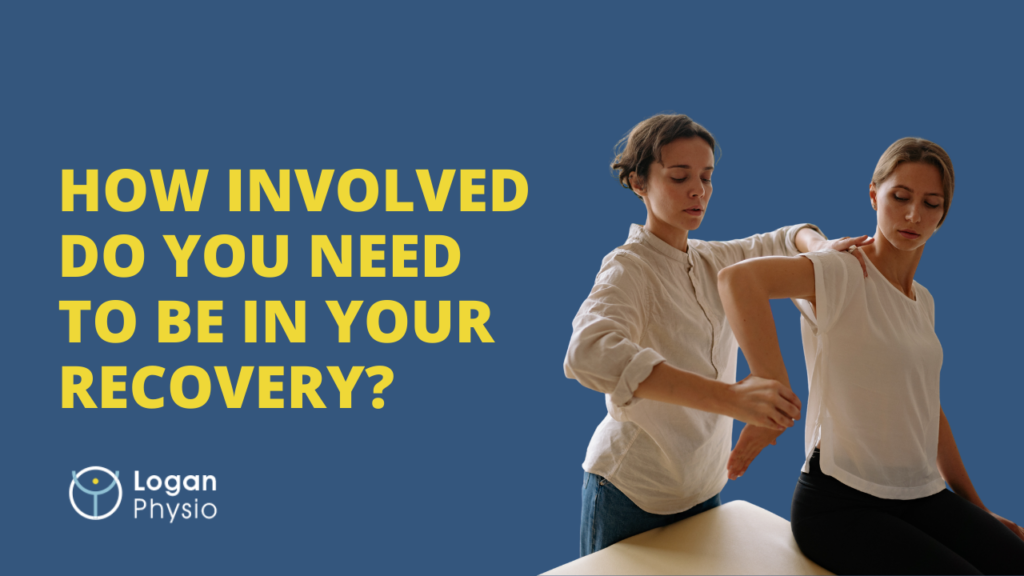
When you’re injured or in pain, it’s natural to want someone else to “fix” it.
You book an appointment.
You show up.
You lie on the treatment table.
And you hope the pain disappears.
But here’s the honest truth: the most successful recoveries aren’t passive. They’re collaborative.
So how involved do you really need to be in your recovery?
Let’s unpack that – because your level of involvement can be the difference between short-term relief and long-term results.
Recovery Is Not a Spectator Sport
Whether you’re dealing with back pain, a sports injury, post-surgical rehab, or persistent neck tension, recovery isn’t something that happens to you.
It’s something that happens with you.
At Logan Physio, we see it every day:
Patients who engage in their recovery tend to progress faster, feel more confident, and maintain their results long term.
That doesn’t mean you need to become a rehab expert overnight. But it does mean you play an active role.
What Does “Being Involved” Actually Mean?
Being involved in your recovery doesn’t mean spending hours in the gym every day. It means:
- ✅ Doing your prescribed exercises consistently
- ✅ Understanding your condition
- ✅ Asking questions
- ✅ Communicating what’s improving (and what’s not)
- ✅ Making small lifestyle adjustments when needed
It’s about partnership.
Your physiotherapist brings the expertise.
You bring the day-to-day follow-through.
And that combination is powerful.
Why Passive Treatment Alone Isn’t Enough
Hands-on treatment can be helpful. Manual therapy, joint mobilisation, soft tissue work – these can reduce pain and improve movement in the short term.
But if nothing changes outside the clinic room, symptoms often return.
Why?
Because pain and injury are rarely caused by a single event. They’re usually influenced by:
- Load and activity levels
- Strength and conditioning
- Movement habits
- Sleep
- Stress
- Recovery capacity
If we only treat symptoms and not the underlying contributors, progress stalls.
Your involvement helps address the drivers – not just the discomfort.
The Science Behind Active Recovery
Research consistently shows that active rehabilitation – exercise-based and education-focused treatment – leads to better long-term outcomes than passive treatment alone.
When you actively participate:
- Your tissues adapt and strengthen
- Your nervous system becomes less sensitive
- Your confidence improves
- Your fear of movement reduces
- Your independence increases
In other words, you don’t just feel better – you become more resilient.
“But I’m Busy…” (And Other Real-Life Barriers)
We get it.
You have work.
Kids.
Sport.
Life.
Adding rehab exercises on top of everything else can feel overwhelming.
That’s why involvement doesn’t mean perfection.
It means consistency over intensity.
Often, we can design a program that takes:
- 10–15 minutes a day
- 3–4 sessions per week
- Simple equipment (or none at all)
The key is sustainability. A small amount done regularly beats a big effort done once.
What Happens When You’re Highly Involved?
When patients take ownership of their recovery, we commonly see:
1. Faster Progress
Consistent loading builds strength and tolerance more efficiently.
2. Fewer Flare-Ups
Understanding your limits helps you adjust before problems escalate.
3. Greater Confidence
You stop feeling fragile and start feeling capable.
4. Long-Term Prevention
You’re not just “fixing” an issue – you’re building resilience against future injury.
This is especially important for recurring problems like:
- Lower back pain
- Tendinopathies
- Shoulder impingement
- Knee pain
- Neck tension
These conditions respond best to progressive, active management.
How Much Is “Enough” Involvement?
Here’s a helpful way to think about it:
Your physiotherapist might see you for:
- 30–45 minutes
- Once per week
That leaves over 10,000 minutes per week where you’re managing things independently.
Your recovery is shaped far more by what happens in those 10,000 minutes than by the 45 you spend in the clinic.
So being “involved enough” means:
- Following through between sessions
- Tracking your symptoms
- Gradually progressing exercises
- Letting us know when something isn’t working
It doesn’t mean doing it alone. It means staying engaged.
Recovery Is a Skill – Not Just a Treatment Plan
One of the most underrated benefits of being involved is skill development.
You learn:
- How to modify activity without stopping completely
- How to manage flare-ups
- How to load safely
- How to listen to your body without fear
These skills last far beyond a single injury.
And that’s often what separates short-term fixes from long-term change.
What If You’ve Tried Before and It Didn’t Work?
Maybe you’ve been given exercises before.
Maybe you lost motivation.
Maybe the pain didn’t improve as expected.
That doesn’t mean you failed.
Sometimes:
- The program wasn’t tailored enough
- The load progressed too quickly (or too slowly)
- The diagnosis missed underlying contributors
- Life simply got in the way
Being involved also means having honest conversations so the plan can adapt.
Recovery isn’t linear. It’s flexible.
The Right Balance: Guidance + Ownership
You shouldn’t feel like you’re doing this alone.
At Logan Physio, our approach is collaborative:
- We assess thoroughly
- We explain clearly
- We tailor your plan
- We adjust based on feedback
- We support you through setbacks
But the momentum?
That comes from your engagement.
Think of it like coaching. The coach designs the program. The athlete does the training.
Both roles matter.
Signs You’re Taking an Active Role in Recovery
You’re likely involved enough if:
- You understand why you’re doing each exercise
- You can describe your progress clearly
- You feel more confident moving
- You’re gradually increasing activity
- You’re not relying solely on hands-on treatment
If you’re unsure, ask your physio:
“What should I be doing between sessions to maximise my recovery?”
That question alone changes outcomes.
The Long-Term Payoff
The goal of physiotherapy isn’t dependency.
It’s independence.
When you’re actively involved, you don’t just recover – you build:
- Strength
- Capacity
- Knowledge
- Confidence
- Control
And that’s empowering.
So… How Involved Do You Need to Be?
More than zero.
Less than perfect.
Consistent. Curious. Engaged.
Your recovery isn’t about doing everything.
It’s about doing the right things – regularly.
If you’re currently dealing with pain or injury and wondering whether you’re doing enough (or unsure where to start), we’re here to guide you.
Book an appointment with our team at Logan Physio, and let’s create a recovery plan that works with your life – not against it.
Because the most powerful rehab tool isn’t just in the clinic.
It’s you.
